
The Best Native Shrubs for Year-Round Interest and Seasonal Color
Native shrubs offer some of the most reliable, low maintenance, and ecologically beneficial options ...
A common mantra in native gardening is “right plant, right place.” This saying reflects the importance of selecting plants that are suited to the specific conditions of your garden. When gardeners and landscapers match plant needs with site conditions, they create more resilient, low-maintenance, and ecologically beneficial landscapes.
Before planting, ask yourself the following questions:
How big is your gardening space?
What is the sun exposure throughout the day?
What is your USDA hardiness zone?
How do you want to use the space (pollinator garden, privacy screen, edible landscape)?
And finally: What type of soil do you have?
Knowing your soil texture is crucial to choosing the best native plants for your yard. While a lab-based soil test from your local university extension office is always an option, you can also perform a simple, effective at-home test using household items to understand your soil’s composition.
This DIY jar test helps determine the ratio of sand, silt, and clay in your soil—key factors that influence drainage, nutrient availability, and plant compatibility.
A clear, straight-sided jar with a tight-fitting lid (such as a mason jar)
A trowel or hand shovel
A large tray or container (if sampling a broad area)
A ruler or measuring tape
A timer (phone, stopwatch, or kitchen timer)
If your gardening space includes multiple zones or beds, you have two testing options:
Blended Sample – Combine soil from various parts of your garden for a general overview.
Individual Samples – Test each garden bed or area separately for more precise results.
Use your trowel to dig down approximately 6 inches, the typical root zone depth. Remove enough soil to fill 1/3 to ½ of your jar. Discard rocks, roots, leaves, and any large debris. Then fill the jar with water until it’s about 80% full. Let the soil absorb the water for a few minutes.
Seal the lid tightly and shake the jar vigorously for 3 full minutes. This will fully break up the soil particles.
Set the jar on a flat surface and allow the particles to settle:
After 1 minute, use your ruler to measure the bottom layer—this is sand.
After 4 minutes, measure the layer that has settled above the sand—this is silt.
After 48 hours, measure the top layer—this is clay.
Use a marker or tape to mark the levels after each stage. This will give you a clear picture of your soil’s composition.
Nursery Entrance  Irrigation Pond
 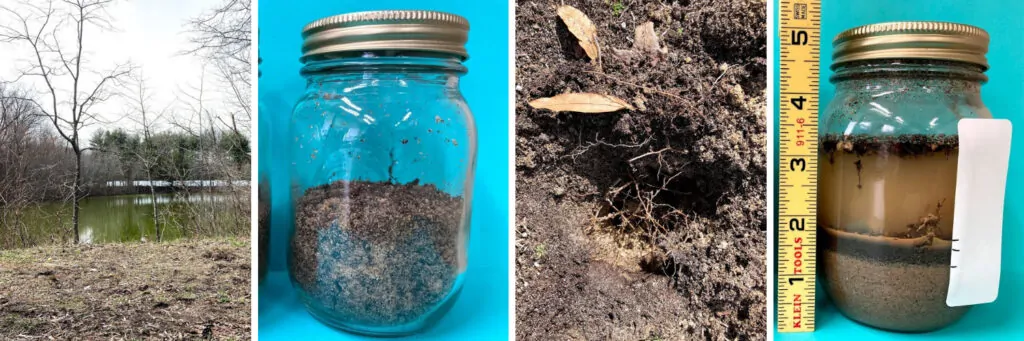 At Direct Native Plants we took soil samples from two different locations: to the left of the nursery entrance and in front of our irrigation pond. As you can see in the photos, both areas are primarily sandy. The entrance is 62% sand/30% silt/8% clay, and the irrigation pond is 77% sand, 15% silt, and 8% clay. As a result, we will be choosing plants that are known to perform well in sandy soil.
A good soil mixture is approximately 20% clay, 40% silt, and 40% sand. If your sample is outside of these parameters, there is a native plant for that! Plants that are native to your region tend to be your best option for meeting the conditions that already exist in your garden. Natives are adapted to local conditions, and if you choose the right plants, there is less need to amend your soil.
Sandy soils drain quickly and tend to be drier than clay or loamy soils.
Clay soils do not drain quickly and tend to stay wet longer that sandy or loamy soils.
Please note, the suggestions above are not extensive; they are simply meant to be a starting point. Looking for a more comprehensive list of plants by soil type? Check out your local university extension for native plant lists and resources. If you’re in the Maryland area, here is the University of Maryland’s list of native plants categorized by soil condition. The US Fish and Wildlife Service’s Native Plants for Wildlife habitat and Conservation Landscaping is also a useful source. Want to stay up-to-date with all of our Native News? Sign up for our email newsletter!